





Electric Vial Crimpers
Compact equipment for laboratory samples, small production batches and multiple compatible cap sizes.
ALUMINUM FLIP-OFF CAP SEALING
Crimp aluminum and flip-off caps securely onto glass vials after stopper placement. ZONESUN supplies electric, pneumatic and fully automatic vial crimpers for laboratory, small-batch and continuous packaging operations.
VIAL CLOSURE GUIDE
A vial crimping machine secures an aluminum or flip-off cap around the neck of a stoppered glass vial. The crimping head forms the aluminum skirt beneath the vial-neck flange to hold the stopper in position.
Machine selection should be based on vial dimensions, cap size, stopper and cap combination, required output and production environment. Physical samples are recommended before confirming the crimping tooling.
MACHINE CONFIGURATIONS
Choose a compact or automatic configuration according to production volume and upstream filling requirements.
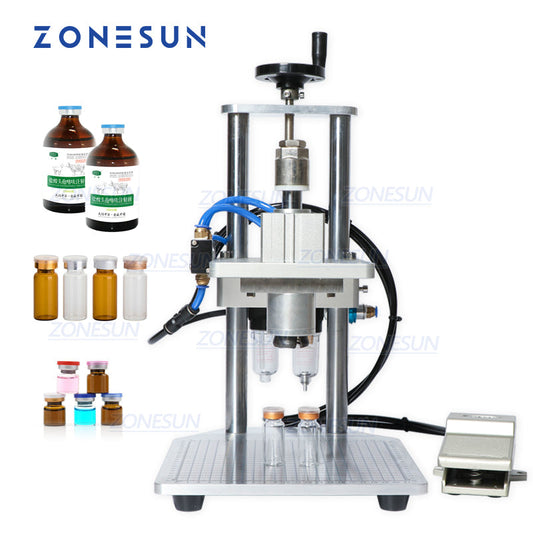
Compact equipment for laboratory samples, small production batches and multiple compatible cap sizes.
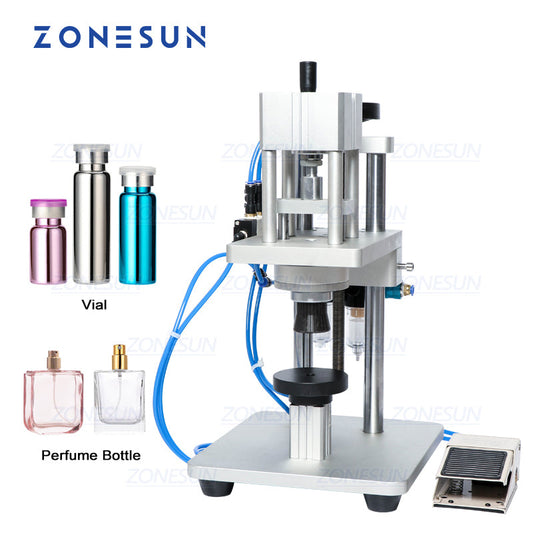
The operator positions the vial while pneumatic force completes the crimping cycle with improved repeatability.
Integrates vial conveying, positioning and continuous crimping for connection with filling equipment.
SELECTION FACTORS
All three components must form a compatible closure system. Cap diameter alone is not enough for machine selection.
Head geometry, pressure and height affect cap formation, stopper compression and finished appearance.
Production speed determines whether manual loading, rotary positioning or a monoblock system is more suitable.
TYPICAL PROCESS
Vial crimping normally follows liquid filling and stopper placement. Every component must be correctly positioned before the aluminum cap is crimped.
CLOSURE DIFFERENCES
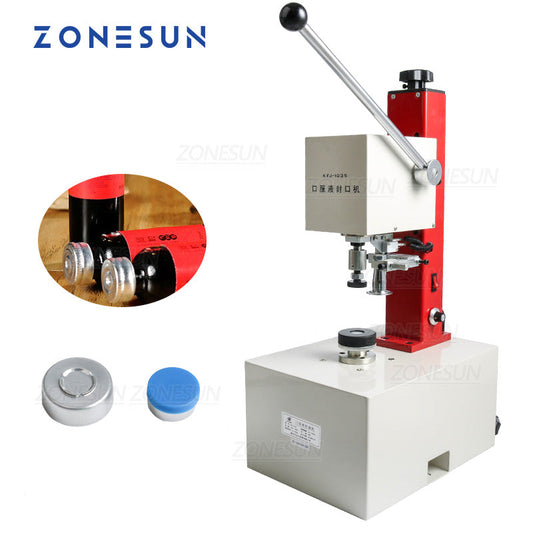
Forms an aluminum skirt beneath the vial-neck flange.
Rotates a threaded cap onto a matching bottle neck.
Forms threads and a tamper-evident band using rollers.
FREQUENTLY ASKED QUESTIONS
Some machines support multiple sizes through height adjustment and interchangeable crimping heads.
The range varies by model and tooling. Provide the actual vial, stopper and cap to confirm compatibility.
This may be possible when their dimensions are compatible, but separate crimping heads may be required.
Yes. Automatic crimpers can connect with vial feeding, filling, stopper insertion and labeling equipment.
Samples allow testing of cap fit, skirt formation, stopper compression and final closure appearance.
Yes. Pneumatic models require a compatible external compressed-air supply.
Send the vial, stopper and cap together so the crimping tooling can be tested accurately.