





Peristaltic Pump Fillers
Product contacts mainly the replaceable tubing, making this method useful for small-volume, clean and free-flowing liquids that require convenient product changeover.
Compact Automated Filling Solutions
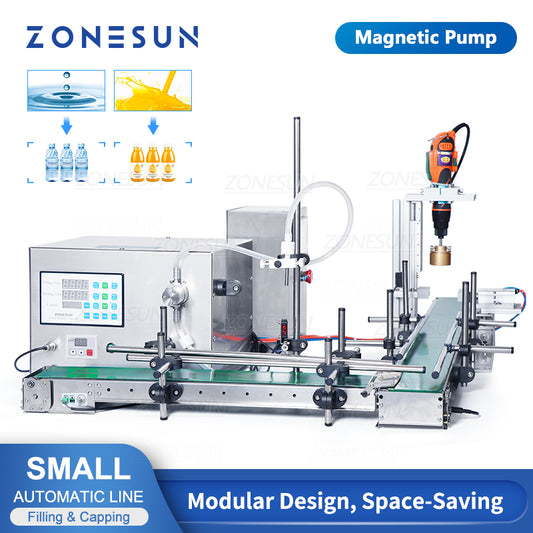
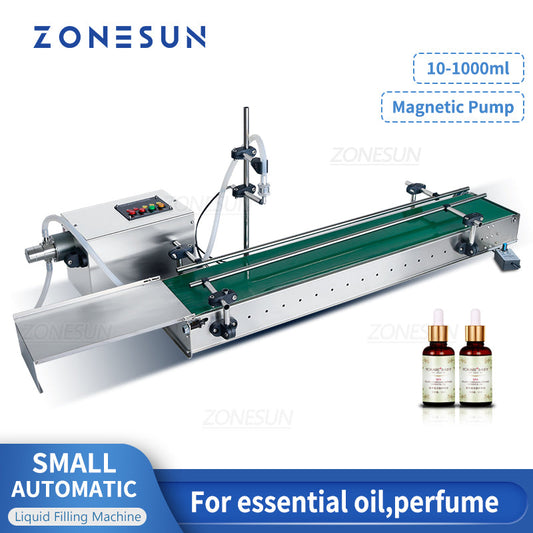
Compact automatic filling machines for small and medium production batches. ZONESUN tabletop systems combine conveyor feeding, container detection and automatic dosing while requiring less installation space than a conventional floor-standing filling line.
Compact Footprint, Automatic Operation
Small automatic fillers bridge the gap between manually operated desktop machines and full-size industrial lines. They automatically detect and fill containers while retaining a compact footprint suitable for limited production space and flexible batch manufacturing.
Product contacts mainly the replaceable tubing, making this method useful for small-volume, clean and free-flowing liquids that require convenient product changeover.
Compact and economical automatic filling for water-like liquids, beverages, cosmetic water and selected daily chemical products.
Provide controllable dosing for suitable low-viscosity, particle-free liquids using adjustable pump speed and filling time.
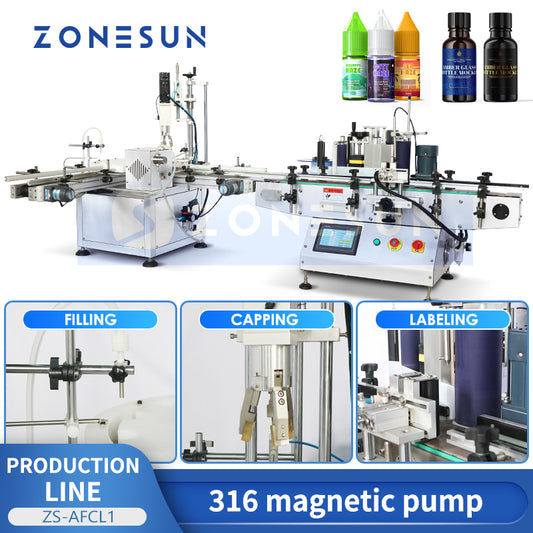
Integrate filling with plugging, capping or other closing operations for essential oils, eye drops and other small containers.
| Machine Type | Container Handling | Typical Use | Production Setup |
|---|---|---|---|
| Semi-Automatic Filler | Containers are placed and removed manually | Samples and small production batches | Standalone operation |
| Small Automatic Filler | Sensor detection and conveyor transfer | Small-to-medium continuous production | Compact tabletop or short conveyor |
| Full-Size Automatic Filler | Integrated conveying and bottle control | Higher-output industrial production | Floor-standing filling line |
| Compact Monoblock | Indexed container positioning | Small bottles requiring filling and closing | Integrated filling and capping unit |
It combines automatic container detection and filling with a compact tabletop or short-conveyor structure. Containers move through the filling station automatically, but the system occupies less space than a conventional industrial filling line.
No. A semi-automatic filler normally requires the operator to place each container beneath the nozzle and initiate filling. A small automatic filler uses sensors and a conveyor to process containers continuously.
Peristaltic pumps suit clean, small-volume liquids and convenient tubing changeover. Diaphragm and magnetic pumps are commonly used for suitable free-flowing liquids. Thick products require a piston, heated hopper or another matched system.
Many compact machines are intended for small bottles, but the filling range, bottle stability, opening diameter and required accuracy must be confirmed. Guides or bottle-holding fixtures may be required.
Compact machines are available with one or multiple filling heads. More heads can increase output, but the conveyor width, bottle spacing, pump capacity and product supply must remain coordinated.
Only when the installed filling system matches both products. Water-like liquids and thick pastes normally require different pumps, tubing, nozzles and feeding structures. Product testing is recommended.
A compact filler can often connect with capping, sealing, labeling and coding equipment. Conveyor height, direction, container spacing and production speed should be confirmed before integration.