






Handheld Induction Sealers
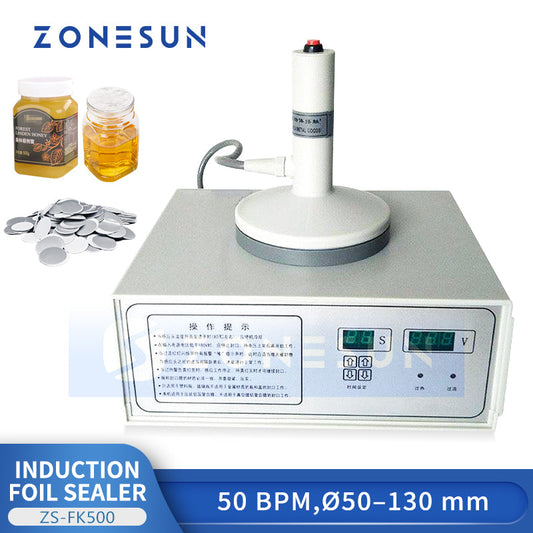
Portable sealing equipment for manual operation, laboratory work, product testing and low-volume bottle packaging.
Bottle Closure & Foil Sealing Solutions
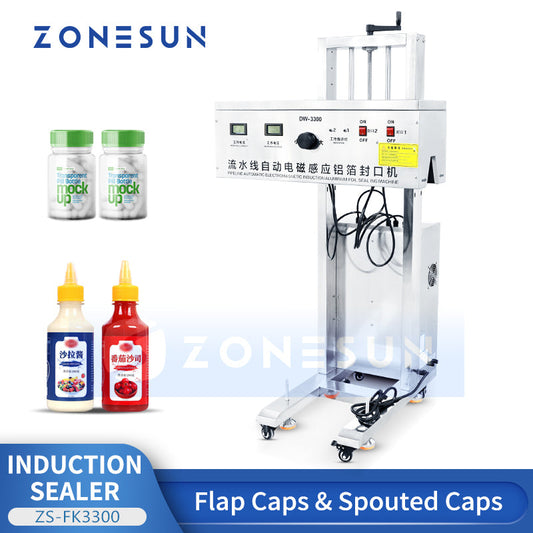
Apply aluminum foil liners securely to bottle openings using non-contact electromagnetic induction. ZONESUN bottle sealing machines include handheld, tabletop and continuous conveyor systems for different production capacities, bottle dimensions and operating environments, with air-cooled and water-cooled configurations available for continuous packaging lines.
Bottle Opening Protection
Electromagnetic induction heats the aluminum layer inside a compatible cap liner without directly contacting the container. The heated sealing layer bonds to the bottle rim, creating a protective inner seal for filled and capped products.
Portable sealing equipment for manual operation, laboratory work, product testing and low-volume bottle packaging.
Compact induction sealing systems for small and medium batches where straightforward operation and limited floor space are important.
Conveyor-based equipment that seals bottles continuously and can be connected with filling, capping and labeling machines.
Industrial sealing configurations designed to manage heat during extended operation and higher-output production.
The sealing head produces a high-frequency electromagnetic field. This heats the aluminum layer in the cap liner, causing its sealing layer to bond to the bottle rim after cooling.
Compatible systems are commonly used with non-metal containers, including suitable plastic, glass and ceramic bottles. The liner sealing layer must also match the bottle material.
Standard induction sealing machines are generally designed for compatible non-metal caps containing an aluminum foil liner. Metal caps may interfere with the electromagnetic field and should not be used unless the system has been specifically designed for them.
In most induction sealing applications, the cap holds the foil liner against the bottle rim during heating. Consistent cap placement and tightening help produce a uniform seal.
Seal quality can be affected by bottle-rim condition, liner compatibility, cap pressure, sealing power, conveyor speed, distance from the sealing head and the temperature of the filled product.
Air-cooled machines use fans to dissipate operating heat and suit many standard applications. Water-cooled systems circulate coolant around relevant components and are often used for extended or higher-output operation.
Compatible inspection equipment can be added after sealing to identify conditions such as missing foil, weak seals, overheating or incorrect cap positioning. Inspection capability depends on the configured system.