






Tabletop Magnetic Pump Fillers
Compact one- or two-head machines for laboratories, small workshops, sample production and frequently changing liquid products.
Clean & Controllable Liquid Dosing
ZONESUN magnetic pump fillers provide controllable volumetric dosing for water-like and low-viscosity, particle-free liquids. Available in compact, semi-automatic and automatic multi-head configurations, these machines support applications in beverages, cosmetics, daily chemicals and other liquid-packaging operations.

Volumetric Filling for Free-Flowing Liquids
A magnetic pump transfers rotational power through magnetic coupling, reducing the need for a conventional shaft seal in the pump structure. Pump running time and speed can be controlled to dispense repeatable volumes of suitable low-viscosity, particle-free liquids.
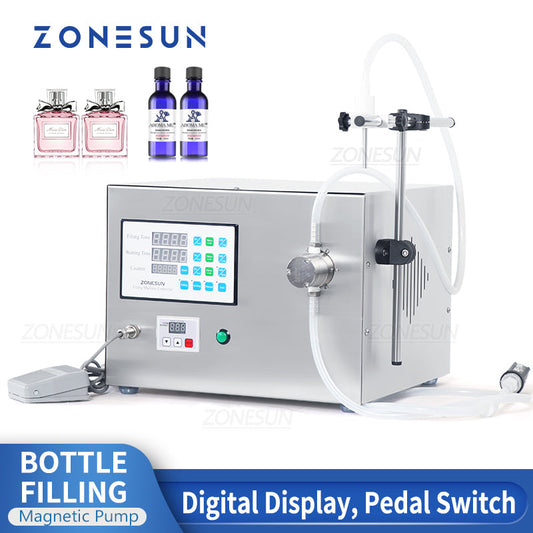
Compact one- or two-head machines for laboratories, small workshops, sample production and frequently changing liquid products.
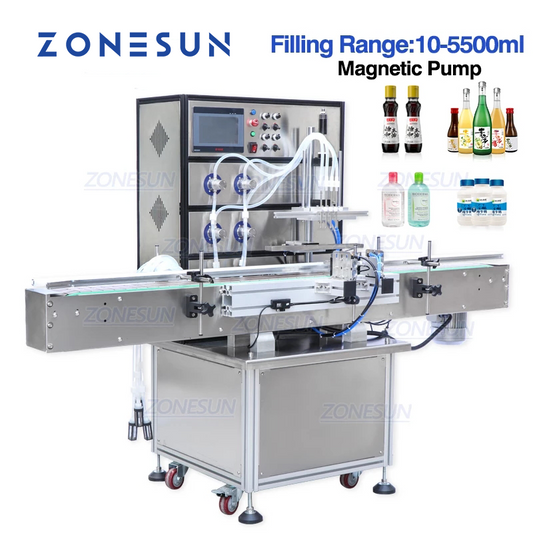
Two-, four- or six-head configurations increase output while allowing filling time and pump speed to be adjusted for each application.
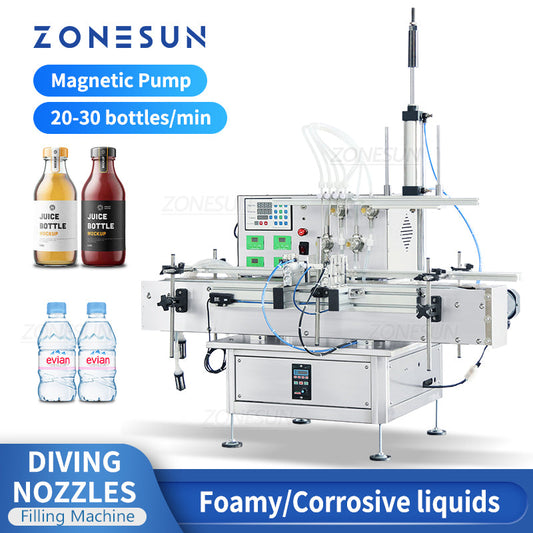
Integrate bottle detection, positioning, filling and conveyor transfer for continuous liquid-packaging production.
Combine magnetic pump filling with plugging, capping, sealing, labeling or spout-pouch closing for a coordinated production line.
The drive motor transfers rotation to the pump through magnetic coupling. The controller regulates pump speed and operating time to dispense the programmed amount of liquid through the filling nozzle.
These fillers are commonly used for water-like, low-viscosity and particle-free liquids. Compatibility depends on viscosity, chemical composition, temperature and the materials used in the liquid path.
Magnetic pumps are generally not the preferred choice for thick creams and pastes. A piston, lobe-pump or other positive-displacement filling system may provide more suitable product handling.
Particles can obstruct or damage a small magnetic pump. Products containing pulp, herbs, crystals, granules or suspended solids should be evaluated for a different pump and filling-valve structure.
Filling volume is typically adjusted through parameters such as pump operating time and speed. The liquid characteristics, tubing, suction height and nozzle size can also influence the final result.
Depending on the machine configuration, individual pump parameters may be fine-tuned to balance the output of multiple nozzles. The available controls should be confirmed for the selected model.
Automatic magnetic pump fillers can be integrated with bottle feeding, plugging, capping, sealing, labeling and coding equipment. Conveyor height, container spacing and line speed should be coordinated.