



Cap Dimensions
Provide the cap diameter, height, material, skirt thickness and tamper-evident band structure.
ALUMINUM PILFER-PROOF CAPPING SOLUTIONS
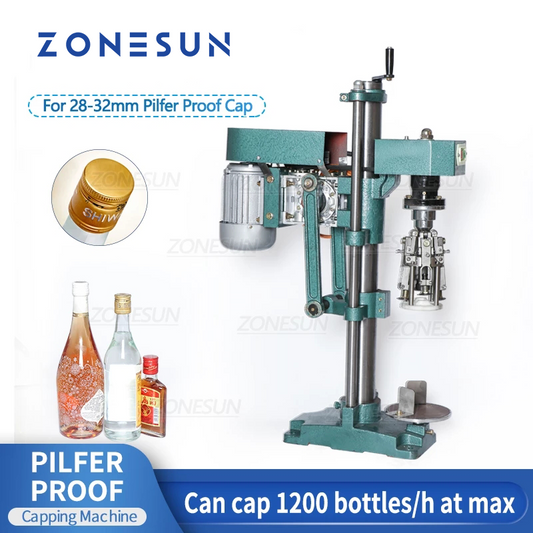
Explore semi-automatic and fully automatic ROPP capping machines for forming secure threads and tamper-evident seals on aluminum caps. Machine configuration can be customized according to your bottle, cap dimensions, required output and production-line layout.
Request a Capping SolutionThese details help us confirm the capping head and machine configuration.
Cap diameter, height, material and skirt thickness.
Bottle shape, dimensions and neck-finish structure.
Required bottles per minute or bottles per hour.
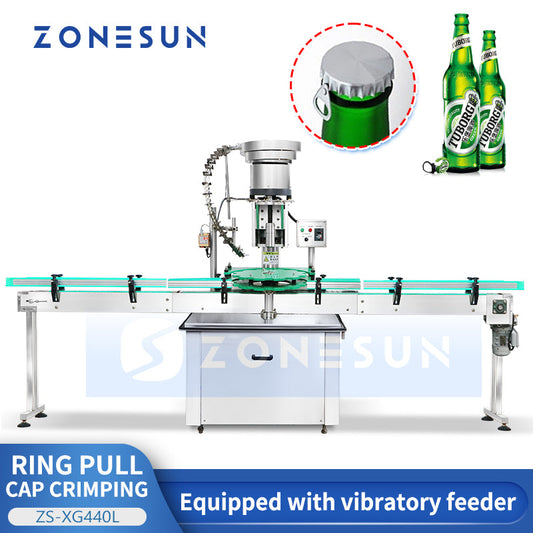
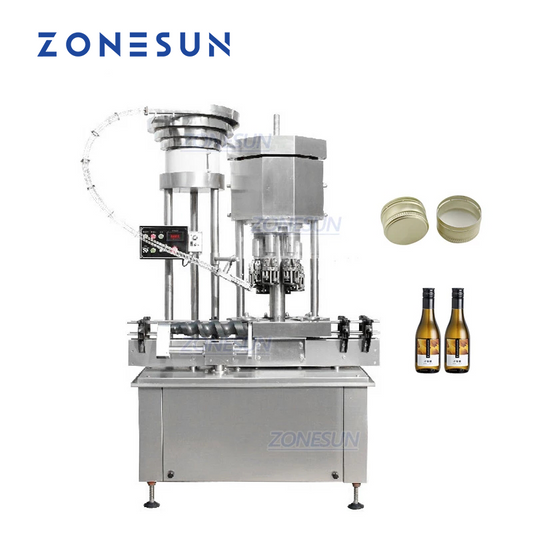
Semi-automatic, inline automatic or multi-head system.
Sending actual bottle and cap samples is recommended for capping-head design and sealing tests.
ROPP CAPPING MACHINE GUIDE
Selecting a ROPP capper requires more than matching the cap diameter. The aluminum cap dimensions, bottle-neck finish, capping output and automation level should be evaluated together to ensure consistent thread forming and tamper-evident sealing.
Five details that determine the capping head, bottle handling system and machine configuration.
Provide the cap diameter, height, material, skirt thickness and tamper-evident band structure.
The neck diameter, thread profile and transfer-ring structure affect roller and head design.
Bottle height, diameter, shape and material determine the conveying and positioning system.
Required bottles per minute determine whether a single-head or multi-head system is appropriate.
Confirm whether the capper will operate independently or connect with filling and labeling equipment.
Choose the automation level according to production output, available labor and packaging-line layout.
| Machine Type | Suitable Production | Typical Advantages | Selection Notes |
|---|---|---|---|
| Semi-Automatic ROPP Capper | Small batches and flexible production | Compact structure, simple operation and lower initial investment | Requires manual cap placement and bottle handling |
| Automatic Inline ROPP Capper | Continuous medium-output bottling lines | Automatic conveying, cap feeding and continuous capping | Bottle spacing and upstream line speed should be confirmed |
| Multi-Head ROPP Capper | High-output industrial production | Multiple capping heads and higher continuous production capacity | Requires customized bottle handling and cap-feeding systems |
CLOSURE FORMING PROCESS
ROPP means Roll-On Pilfer-Proof. Unlike a pre-threaded screw cap, the aluminum closure is formed around the bottle-neck thread during the capping process.
The capping head and forming rollers must match the actual cap dimensions and bottle-neck finish.
The aluminum cap is positioned on the bottle neck manually or by an automatic cap-feeding system.
The bottle is centered and stabilized beneath the ROPP capping head.
Thread rollers press the aluminum skirt against the bottle-neck thread.
Lower rollers form the pilfer-proof band beneath the bottle-neck ring.
ROPP closures are commonly selected for products requiring a secure aluminum cap and visible tamper evidence.
Wine, whisky, vodka, liqueur and other bottled alcoholic products.
Juice, drinking water, functional beverages and bottled drinks.
Olive oil, cooking oil and other specialty bottled food oils.
Syrups, oral liquids and other compatible pharmaceutical products.
Providing these details helps us evaluate the capping head, change parts and recommended automation level.
Testing actual bottles and caps helps confirm thread forming, tamper-band sealing and bottle handling.
Send bottle and cap dimensions, photos and the required output.
Evaluate the capping head, rollers and bottle-positioning parts.
Test capping quality using actual bottles and caps when possible.
Confirm the machine model, configuration and optional equipment.
Common questions about ROPP caps, tooling and machine selection.
CUSTOM ROPP CAPPING SOLUTION
Send us your bottle and cap dimensions, sample photos, required production output and packaging-line layout for evaluation.