




Aerosol Liquid Fillers
Dispense the required amount of liquid product into compatible aerosol cans before the valve is installed and sealed.
Pressurized Can Packaging Solutions
Fill products, install and crimp aerosol valves, charge compatible propellants, and assemble spray actuators using equipment configured for the required aerosol package. ZONESUN supplies manual, semi-automatic and integrated aerosol systems, including conventional aerosol and Bag-on-Valve filling solutions.
Aerosol Packaging Equipment
Aerosol packaging requires coordinated product filling, valve placement, controlled crimping, propellant charging and pressure inspection. The machine configuration must match the product formula, aerosol can, valve, actuator, propellant and applicable factory-safety requirements.
Dispense the required amount of liquid product into compatible aerosol cans before the valve is installed and sealed.
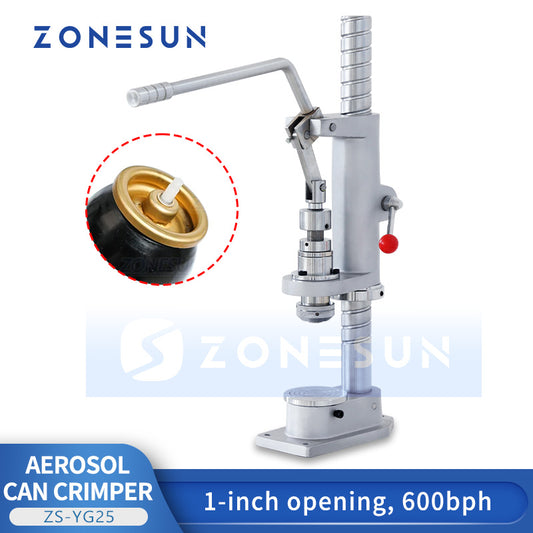
Position and mechanically crimp compatible aerosol valves to the can opening using tooling matched to the valve and container.
Charge a compatible propellant through the configured filling system after the valve has been sealed to the aerosol can.
Combine liquid filling, valve crimping and gas charging in a compact three-in-one machine or an automatic production line.
Manual or pneumatic liquid fillers, valve crimpers and gas fillers support low-output production and flexible equipment arrangement.
Combines product filling, valve crimping and gas charging in one compact system while retaining operator-assisted can handling.
Connects filling, valve placement, crimping, gas charging, inspection and actuator or cap assembly through an automated conveying system.
| Comparison | Conventional Aerosol | Bag-on-Valve Aerosol |
|---|---|---|
| Product Position | The product and compatible propellant occupy the aerosol container according to the selected formulation. | The product is held inside a flexible bag attached to the aerosol valve. |
| Pressure Medium | Uses a propellant selected for the product, valve and intended spray performance. | Pressure is applied outside the bag so the pressure medium remains separated from the product. |
| Filling Sequence | Commonly includes product filling, valve crimping and propellant charging. | Requires BOV-compatible bagged valves, pressure charging, crimping and product filling through the valve system. |
| Machine Requirement | Requires equipment matched to the can, valve, product and selected propellant. | Requires dedicated BOV filling and crimping equipment matched to the bagged valve and can. |
Depending on its configuration, it can dispense the liquid product, crimp the aerosol valve and charge a compatible propellant. These functions may be performed by separate machines or one integrated system.
BOV means Bag-on-Valve. The product is filled into a flexible bag attached to the aerosol valve, while the pressure medium remains in the space between the bag and the can.
Not automatically. BOV containers require compatible bagged valves, dedicated filling heads, suitable crimping tooling and a different filling sequence. The machine must be designed or configured specifically for the selected BOV package.
A three-in-one aerosol machine can combine liquid-product filling, valve crimping and compatible propellant charging. Its filling heads, valves and controls must match the intended materials.
Crimping mechanically secures and seals the valve to the aerosol can. The crimp diameter, crimp depth and tooling must match the selected can and valve specifications.
A machine may handle compatible aluminum or tinplate aerosol cans, but the can dimensions, neck specification, valve, positioning parts and crimping tooling must be confirmed for every format.
The process may include fill-weight checks, crimp inspection, pressure or leakage testing, water-bath testing where appropriate, actuator inspection and final functional testing according to the product and applicable requirements.
Provide the product formula, target liquid volume, selected propellant, can and valve specifications, actuator, required output, operating environment, local safety requirements and actual package samples where possible.